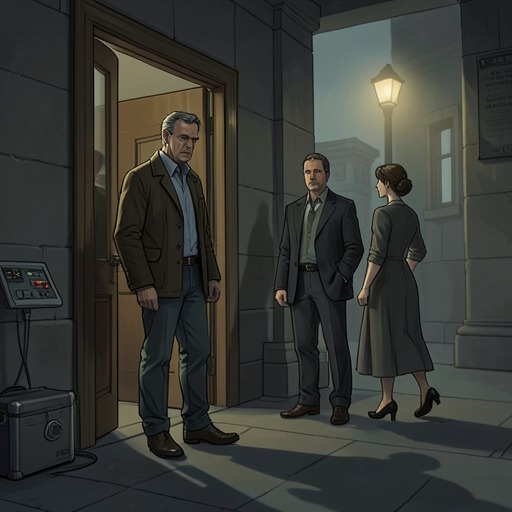
Trish Daniels
After We CollidedTrish Daniels, Hardin Scott’s mother, enters the story as an exuberant and affectionate presence, but her warmth does not make her blind to the harm her son can cause. She welcomes Tessa Young while recognizing the risks of Tessa’s relationship with Hardin, and she becomes a participant in the family conflicts that link his past to his present. Her role is defined by that difficult balance: supporting her son, defending Tessa’s agency, and sometimes urging Tessa to protect herself from him.
Identity and Background
Trish is introduced as Hardin’s mother, with an accent Tessa recognizes as matching her son’s. She and Hardin have a history that reaches beyond the immediate romantic conflict: after Ken Scott left, Trish and Hardin lived with Christian Vance for a year. Trish later recalls this while speaking with Tessa, but stops short of explaining the circumstances, noting that Hardin dislikes her speaking too freely about the past. The unfinished recollection establishes that the family rupture is not a settled story even between mother and son.
Her history with Ken emerges more fully during a confrontation at Ken’s home. Hardin accuses his father of leaving them without money or a car; Ken counters that he sent money monthly and offered a car, which Trish refused. She clarifies that money was also used to pay household bills, not only Hardin’s tuition. The disagreement preserves a gap between the parents’ accounts and Hardin’s experience of deprivation: Trish’s disclosure explains how the money was used without resolving his sense that his father abandoned them.
Meeting Tessa
Trish arrives at the apartment with Hardin carrying her floral-print luggage. Hardin had told her that Tessa would be away that week, apparently to surprise his mother; instead, Trish finds Tessa there amid her food, laundry, and recently cleaned rooms. She immediately recognizes Tessa and greets her with such enthusiasm that Hardin has to ask his mother to give the shy young woman some space. Trish has already heard a great deal about Tessa from Hardin, a fact that surprises Tessa, who had assumed he kept their relationship secret.
The welcome is intimate rather than formal. Trish hugs Tessa repeatedly, praises her, and invites her to use her first name instead of addressing her as ma’am. Their conversation also connects Tessa’s university life to Hardin’s: Tessa is an English major like him and has an internship at Vance Publishing. When she hears Christian Vance’s name, Trish recalls that she and Hardin lived with him for a year after Ken left. The exchange lets Tessa see both Trish’s open affection and the guarded edge around family history.
Protectiveness and Conflicted Advice
Trish’s relationship with Tessa becomes more complicated when Tessa’s mother, Mrs. White, confronts the couple. Trish argues that Tessa and Hardin are adults and that Tessa should be allowed to decide whether to stay. When Mrs. White condemns Hardin for what he did to Tessa, Trish answers that Tessa has chosen to forgive him and that her mother must accept that choice. In this moment, Trish defends Tessa’s right to make her own decision against a parent trying to make it for her.
The scene does not make Trish an uncomplicated advocate for the relationship. When Tessa finally insists that she is an adult and will stay if she chooses, Trish urges her to listen to her mother. That reversal complicates her earlier defense: Trish acknowledges Tessa’s autonomy, yet does not simply encourage her to remain with Hardin. Her response suggests the pressure of holding both positions at once—respecting Tessa’s decision while fearing its consequences.
That fear becomes explicit in a private conversation with Hardin. Trish explains that she told Tessa to leave because she does not believe Hardin is good for her; she does not want Tessa to end up like Natalie or the other women Hardin has hurt. Hardin answers that he knows he has not been good for Tessa, regrets what he did, and believes he can change. Trish questions whether his plea is another version of his own game. Her concern is not presented as abstract disapproval: it is grounded in Hardin’s history and the possibility that his declarations of need may again put his desires ahead of Tessa’s safety.
Mother and Son Amid Family Conflict
Trish’s care for Hardin is visible even during conflict. When the argument with Ken escalates, she puts a hand on her son’s shoulder. Ken explains that he was an alcoholic and believed that Trish and Hardin deserved better than what he could give them; he says he left after a particular night. Hardin immediately rejects the account and blames his father for what happened. Trish’s gesture places her beside Hardin in the confrontation, but it does not erase the unresolved disagreement about Ken’s departure or what the family endured afterward.
Later, Hardin considers calling his father to prevent the recent fight from destroying the beginning of a renewed relationship. That possibility shows the family conflict still shaping his choices: even after anger and physical violence, he considers reaching out. Trish’s earlier recollections and her presence during the confrontation frame this attempted repair as part of a longer history, not a sudden reconciliation. The evidence leaves the outcome open, but shows how her family’s past remains active in the present.
Narrative Role
Trish connects Tessa’s romantic crisis to the family history behind Hardin’s volatility. She can welcome Tessa warmly, defend her right to choose, and still warn that Hardin may hurt her; her shifting interventions resist a simple division between approval and rejection. Her account of the household finances also complicates the conflict between Ken and Hardin without settling it, while her concern about Natalie makes the consequences of Hardin’s past impossible to treat as merely private. Through Trish, affection becomes both an invitation into the family and a warning about what that family has carried forward.